VOSA: what happened to it, and who does its job now
VOSA — the Vehicle and Operator Services Agency — stopped existing on 31 March 2014. From 1 April its testing, roadside enforcement and operator work passed to the Driver and Vehicle Standards Agency, formed by merging VOSA with the Driving Standards Agency. There is no VOSA to contact, no VOSA to appeal to and no VOSA paperwork that is still being issued.
The name has outlived the agency by more than a decade, which is mostly harmless and occasionally revealing. This is what VOSA did, what replaced it, and what the published enforcement record shows has actually changed since.
What VOSA was
VOSA ran from 2003 to 2014 and was the vehicle and operator half of road transport enforcement in Great Britain. Annual testing of goods vehicles, buses, coaches and trailers. Roadside checks. Visits to operating centres. The administrative machinery behind the Traffic Commissioners. If it involved a lorry, a trailer or the business running them, it was VOSA's.
The Driving Standards Agency was the other half: the driving test, the theory test, approved driving instructors, Driver CPC. Drivers rather than vehicles.
The 2014 merger put both under one agency, which is why DVSA today tests your vehicle and examines the person driving it. It is still not the body that grants or takes away an operator's licence — that is the Traffic Commissioner, who is independent of DVSA. DVSA investigates and reports; the Commissioner decides. That division survived the merger unchanged, and operators still address the wrong one.
Why the name has not gone away
Twelve years on, the trade still says a VOSA stop, a VOSA check, a VOSA prohibition. Nobody is confused in conversation and nobody needs to be corrected in a yard. The place it matters is in your own documents.
A driver handbook that tells drivers what to do at a VOSA roadside check is usually not wrong about the procedure. It is telling you something else: that nobody has reviewed the document since before the agency changed. Whatever else is in there has been sitting unexamined for the same twelve years — the defect reporting route, the daily check standard, the escalation names, the phone numbers.
That is the actual finding when the name turns up during an assessment. Not the name. The date it implies. The fix is a review with a date on it rather than a find-and-replace.
Where VOSA still legitimately appears is in historical records: an old prohibition, a past investigation, a certificate issued at the time. Those are valid and do not need rewriting. A qualification is not invalidated by the awarding body being renamed.
The enforcement VOSA ran, against the enforcement you meet now
| Period | Value |
|---|---|
| 2013 to 2014 | 38.8k |
| 2014 to 2015 | 37.2k |
| 2015 to 2016 | 29k |
| 2016 to 2017 | 26.7k |
| 2017 to 2018 | 28.7k |
| 2018 to 2019 | 23.3k |
| 2019 to 2020 | 19.4k |
| 2020 to 2021 | 16.5k |
| 2021 to 2022 | 20.2k |
| 2022 to 2023 | 17.7k |
| 2023 to 2024 | 13.6k |
| 2024 to 2025 | 11.2k |
| 2025 to 2026 | 12.2k |
Use this chart
Free to use on your own site, in a report or in training material, as long as the credit link stays on it. The figures are FleetOptix's working of a published data set — the source is named above, and you should cite that too.
<figure>
  <img src="https://fleetoptix.co.uk/charts/vosa-what-happened-to-it/0.svg" alt="Roadside mechanical checks on GB-registered HGVs — FleetOptix" width="720" height="364" loading="lazy">
  <figcaption>
    Chart by <a href="https://fleetoptix.co.uk">FleetOptix</a>
  </figcaption>
</figure>Or take the file on its own: download the SVG.
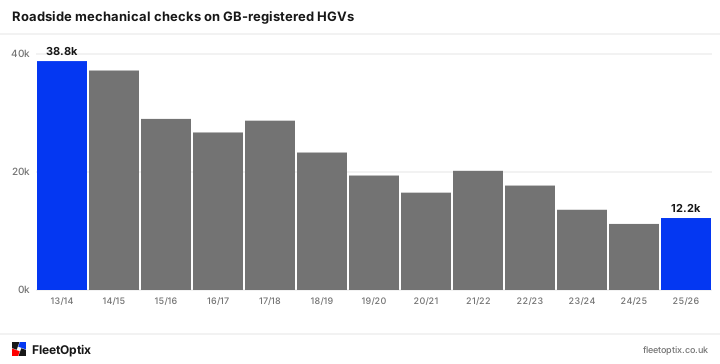
In 2013 to 2014, VOSA's final year, 38,816 roadside mechanical checks were carried out on GB-registered HGVs. 12,089 of them ended in a prohibition — 31.1%. In 2025 to 2026 DVSA carried out 12,178 of the same checks and issued 3,307 prohibitions, 27.2%.
So roughly a third as many checks, at a broadly similar hit rate. The volume did not fall because roadworthiness stopped mattering. It fell because the approach changed: fewer stops, chosen from OCRS scores, intelligence and previous encounters, rather than more stops chosen from traffic flow. The same pattern shows up far more sharply in maintenance assessments, where the unsatisfactory rate has reached 92%.
For an operator the practical consequence is that a stop carries more information than it used to. Being pulled in 2013 was closer to bad luck. Being pulled now is more often the result of something already on record.
One thing that genuinely improved
| Period | Value |
|---|---|
| 2013 to 2014 | 7.5% |
| 2014 to 2015 | 7.3% |
| 2015 to 2016 | 7.1% |
| 2016 to 2017 | 5.1% |
| 2017 to 2018 | 4.3% |
| 2018 to 2019 | 3.7% |
| 2019 to 2020 | 2.9% |
| 2020 to 2021 | 2.2% |
| 2021 to 2022 | 2.1% |
| 2022 to 2023 | 2.4% |
| 2023 to 2024 | 3% |
| 2024 to 2025 | 2.8% |
| 2025 to 2026 | 2.4% |
Use this chart
Free to use on your own site, in a report or in training material, as long as the credit link stays on it. The figures are FleetOptix's working of a published data set — the source is named above, and you should cite that too.
<figure>
  <img src="https://fleetoptix.co.uk/charts/vosa-what-happened-to-it/1.svg" alt="Drivers' hours prohibitions as a share of traffic checks, GB-registered HGVs — FleetOptix" width="720" height="364" loading="lazy">
  <figcaption>
    Chart by <a href="https://fleetoptix.co.uk">FleetOptix</a>
  </figcaption>
</figure>Or take the file on its own: download the SVG.
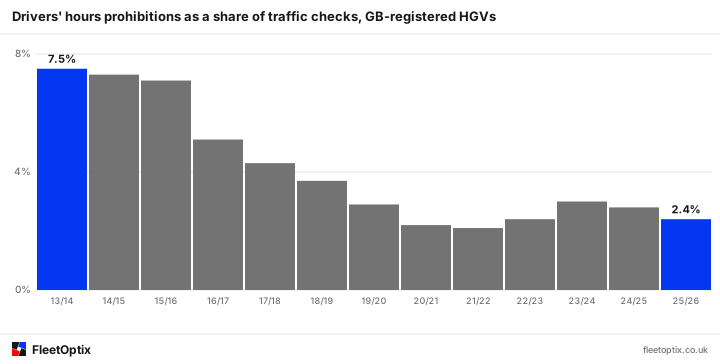
This one is not a targeting artefact, because traffic check volumes fell by a similar proportion to the checks themselves and the rate still dropped by two thirds. In VOSA's last year, roughly one GB HGV traffic check in thirteen produced a drivers' hours prohibition. It is now closer to one in forty.
The obvious explanation is the tachograph. Digital units became mandatory on new vehicles in 2006, which made a driver's record legible and hard to argue with; analysis software made it legible to the operator before the roadside saw it; the smart tachograph followed. An operator who can see an infringement the day after it happens is in a different position from one who found out at a roadside check. The common causes of infringements have not changed much — what changed is who sees them first.
The rate has drifted up again since 2021 to 2022, which is worth watching rather than explaining. Three years is not a trend.
What the merger changed for operators, and what it did not
- The operator's licence is still granted, varied and revoked by the Traffic Commissioner, not by DVSA.
- Annual testing, roadside checks and maintenance assessments all sit with DVSA, as they sat with VOSA.
- Driver testing and Driver CPC moved in from DSA, so one agency now covers both the vehicle and the driver.
- Prohibition notices work the same way and carry the same weight; only the letterhead changed.
- DVLA is still a different agency entirely — it registers vehicles and licenses drivers, and handles none of the above.
- Certificates, records and decisions issued under the VOSA name remain valid.
If your documents still say VOSA
- Search your driver handbook, induction pack and defect procedure for the word, and treat every hit as a review trigger rather than a typo.
- Check the escalation route in those documents actually exists — names and numbers age faster than agency names do.
- Confirm the defect reporting standard still matches what your drivers are asked to do on a walkaround check.
- Date the reviewed version. An undated procedure is the problem the old name was pointing at.
- Leave historical records alone. A 2012 prohibition is a 2012 prohibition.
- VOSA was abolished on 31 March 2014; DVSA took over its functions on 1 April 2014, formed by merging VOSA with the Driving Standards Agency.
- DVSA still does not grant or revoke operator licences — that remains with the Traffic Commissioner.
- Roadside mechanical checks on GB-registered HGVs fell from 38,816 in VOSA's last year to 12,178 in 2025 to 2026, at a broadly similar prohibition rate.
- Drivers' hours prohibitions fell from 7.5% of traffic checks to 2.4% over the same period — a genuine improvement, not a sampling effect.
- The name surviving in your own documents is a dating problem, not a naming one.
- GOV.UK: Vehicle and Operator Services Agency — the archived agency page, which gives VOSA's existence as 3 April 2003 to 31 March 2014
- GOV.UK: Driver and Vehicle Standards Agency — the successor agency and its current remit
- DVSA: Vehicle enforcement data for Great Britain — tables DVSA/ENF/01 and DVSA/ENF/04, the source of every figure and both charts above
Links checked 22 October 2026. Published guidance changes; where a figure matters to a decision, confirm it against the source rather than against this page.
About this article
The FleetOptix team
Written by people who work daily with fleet operators on drivers' hours, tachograph records and the paperwork that holds up under a DVSA inspection. Regulated detail is attributed to the body that sets it rather than asserted here, and the sources are listed above.
- Published
- 22 October 2026
- Last revised
- Not since publication
- Topic
- Operator Licence
How this is researched, dated and corrected is set out in our editorial standards. If something here is wrong or out of date, email hello@fleetoptix.co.uk — corrections to a regulated detail are made as soon as we can confirm them, and the revision date above moves when they are.