DVSA enforcement actions: what each one is, and what follows it
"DVSA enforcement action" is not one thing. It covers an immediate prohibition that strands a vehicle at the roadside, a £50 fixed penalty paid on the spot, a deposit taken from a driver with no UK address, and a report that ends at a public inquiry two years later. They are not graded versions of each other and they do not follow one another in order.
This is what each one is, what it does to the vehicle and to the licence, and what DVSA's own published figures show about who actually gets them.
Prohibitions: the vehicle stops
A prohibition notice stops a vehicle being used. DVSA's own guidance describes it as an enforcement tool to remove an immediate threat to road safety rather than as a punishment, which is a useful way to read it: it is about the vehicle, not about blame.
- An immediate prohibition takes effect at once. The vehicle does not move until the defect is fixed and the prohibition is cleared.
- A delayed prohibition gives a short period — commonly up to ten days — to get the work done, so the vehicle can finish the job and be repaired.
- An S-marked prohibition is the one that matters to the licence. The S means the examiner judged the defect to show a significant failure of the maintenance system rather than bad luck on the day.
The S mark is the whole game. An immediate prohibition for a blown bulb is an inconvenience. The same prohibition S-marked is a statement on your record that your inspection regime should have caught it and did not, and it is read that way by the Traffic Commissioner. How prohibitions are graded and cleared is worth knowing before you meet one.
Prohibitions also feed OCRS, the risk score that decides how likely you are to be stopped again. That is the loop: a prohibition raises the score, the score raises the stop rate, the stops find more. Operators who do not break the loop early tend not to break it at all.
Who actually collects prohibitions
| Period | Value |
|---|---|
| Light goods vehicles | 68.7% |
| Cars | 68.2% |
| Taxis | 67.6% |
| Trailers | 30.3% |
| HGVs | 27.1% |
| Buses and coaches | 21.9% |
Use this chart
Free to use on your own site, in a report or in training material, as long as the credit link stays on it. The figures are FleetOptix's working of a published data set — the source is named above, and you should cite that too.
<figure>
  <img src="https://fleetoptix.co.uk/charts/dvsa-enforcement-actions-explained/0.svg" alt="Share of roadside mechanical checks ending in a prohibition, GB-registered, 2024 to 2025 — FleetOptix" width="720" height="364" loading="lazy">
  <figcaption>
    Chart by <a href="https://fleetoptix.co.uk">FleetOptix</a>
  </figcaption>
</figure>Or take the file on its own: download the SVG.
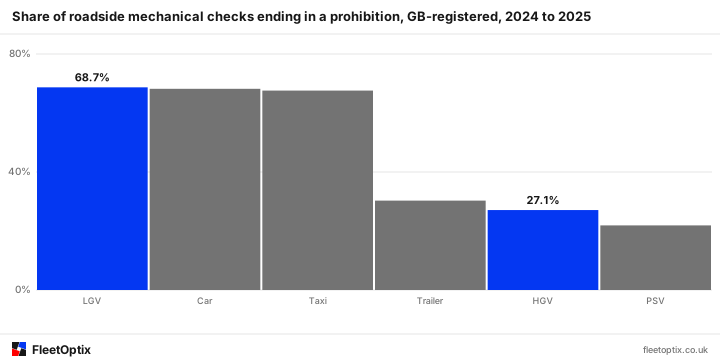
Light goods vehicles fail a roadside mechanical check at two and a half times the HGV rate. Not because vans are worse machines, but because an HGV sits inside a regulated system — an operator's licence, a named transport manager, inspection intervals, an annual test — and a 3.5-tonne van usually does not.
That gap is the single most useful number in this data set for anyone running a mixed fleet. The vehicles with no licensing regime behind them are the ones DVSA finds defective most often, and they are generally the ones with the least internal scrutiny. Van and LCV compliance is the part of a fleet that most often runs on assumption.
Buses and coaches come out best, at 21.9%. Trailers, at 30.3%, come out worse than the units pulling them — which is the recurring finding in trailer compliance: the half of the combination that nobody has a driver assigned to.
Fixed penalties: the driver pays
DVSA examiners can issue graduated fixed penalties at the roadside. Graduated means the amount scales with the seriousness of the offence, and the scale is set in legislation rather than left to the examiner. DVSA's published guide describes bands running from a verbal warning, through £50, £100, £200 and £300, to prosecution for the most serious.
Treat those amounts as a guide and check DVSA's current page on roadside fines and financial deposits before relying on a figure. The bands have been stable for years, but the detail of which offence falls where is exactly the sort of thing that moves without announcement.
- Drivers' hours offences are graduated by how far the limit was exceeded, with examiners generally allowing a short period of leeway before a notice is issued.
- Overloading is graduated by the percentage over the limit, again with a published leeway before a penalty or prohibition.
- A fixed penalty can also follow an S-marked immediate prohibition on a GB-registered vehicle, under DVSA's enforcement sanctions policy.
- DVSA has been able to issue penalties for drivers' hours offences committed in the previous 28 days, not only for what is found on the day.
That last point is the one operators underestimate. A roadside check is not a snapshot. The examiner can look back across the recent record, which means the download and retention regime you run at the depot is what determines how a roadside stop goes.
A driver without a verifiable UK address does not escape it. They are asked for a financial deposit equal to the penalty, and the vehicle is prohibited from moving until it is paid. In 2025 to 2026 DVSA issued 17,122 fixed penalties to non-GB-registered HGVs totalling £4.16m, against 2,527 and £428,000 for GB-registered ones.
Offence rectification and the paperwork route
Not every finding produces a penalty. For lesser matters an examiner may issue an offence rectification notice, which requires the fault to be corrected and evidence provided within a set period. It is the cheapest outcome on the list and the easiest to treat as nothing — which is a mistake, because it is still a recorded encounter and it still has to be closed.
The same applies to a prohibition cleared quickly. Clearing it ends the immediate problem; it does not remove the encounter from your record or its effect on your score.
The slow one: a report to the Traffic Commissioner
The enforcement action with the largest consequence is the one that happens nowhere near a roadside. DVSA investigates and reports; the Traffic Commissioner decides what happens to the licence. A pattern of S-marked prohibitions, a poor maintenance assessment, or a serious drivers' hours finding can all end in a referral.
The Commissioner's powers run from a formal warning, through curtailment of the number of vehicles authorised, to suspension and revocation, and to a finding against the transport manager's repute personally. More than nine in ten DVSA maintenance assessments now come back unsatisfactory, so the step from investigation to referral is not a remote one.
What is being judged at that point is not the defect. It is whether the operation has a system, whether the system was followed, and whether the evidence exists to show it. That is also the whole content of what triggers a public inquiry.
Has roadside enforcement got harsher?
| Period | Value |
|---|---|
| 2013 to 2014 | 31.1% |
| 2014 to 2015 | 30.7% |
| 2015 to 2016 | 30.1% |
| 2016 to 2017 | 27.8% |
| 2017 to 2018 | 24.7% |
| 2018 to 2019 | 25.2% |
| 2019 to 2020 | 19.8% |
| 2020 to 2021 | 20.2% |
| 2021 to 2022 | 19.4% |
| 2022 to 2023 | 23.5% |
| 2023 to 2024 | 26.1% |
| 2024 to 2025 | 27.1% |
| 2025 to 2026 | 27.2% |
Use this chart
Free to use on your own site, in a report or in training material, as long as the credit link stays on it. The figures are FleetOptix's working of a published data set — the source is named above, and you should cite that too.
<figure>
  <img src="https://fleetoptix.co.uk/charts/dvsa-enforcement-actions-explained/1.svg" alt="Share of roadside mechanical checks ending in a prohibition, GB-registered HGVs — FleetOptix" width="720" height="364" loading="lazy">
  <figcaption>
    Chart by <a href="https://fleetoptix.co.uk">FleetOptix</a>
  </figcaption>
</figure>Or take the file on its own: download the SVG.
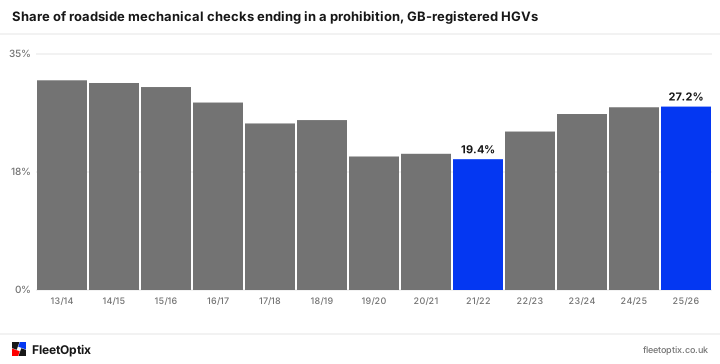
The rate fell for most of the last decade, bottomed at 19.4% in 2021 to 2022, and has climbed every year since to 27.2%. Over the same three years the number of checks fell from 20,154 to 12,178.
Fewer stops finding more defects is what better targeting looks like, and it is the same shape as the assessment data. It does not say vehicles are getting worse. It says DVSA is getting better at choosing which ones to look at — and the operators it chooses are not chosen at random.
What this means for how you run the fleet
- Treat an S-marked prohibition as a systems finding, not a defect. Fix the inspection regime that missed it, and record that you did.
- Close offence rectification notices properly. An unclosed minor notice is the cheapest avoidable entry on a record.
- Check the vans. The published prohibition rate for light goods vehicles is two and a half times the HGV rate.
- Give trailers an owner. They fail more often than the units that pull them and nobody is assigned to them.
- Assume a roadside check can look back 28 days, and run the tachograph analysis that makes that survivable.
- Keep the evidence trail from defect to repair to sign-off in one place, because every route above ends with somebody asking to see it.
- Prohibitions stop the vehicle; fixed penalties charge the driver; referrals to the Traffic Commissioner are what put the licence at risk.
- The S mark on a prohibition is the signal that the maintenance system, not the component, is the finding.
- Light goods vehicles ended 68.7% of roadside mechanical checks in a prohibition in 2024 to 2025, against 27.1% for HGVs.
- Graduated fixed penalties run from a verbal warning to £300 and then to prosecution; confirm the current bands with DVSA before quoting them.
- DVSA can act on drivers' hours offences from the previous 28 days, so a roadside check is not a snapshot.
- The HGV prohibition rate has risen from 19.4% to 27.2% in four years while check volumes fell — targeting, not deterioration.
- DVSA: roadside checks, fines and financial deposits — the graduated penalty bands, the leeway allowed, and how deposits work
- GOV.UK: roadside vehicle checks for commercial drivers — prohibitions, fixed penalties and what happens at a check
- DVSA: drivers' hours and tachographs — enforcement and penalties — how prohibitions and penalties apply to drivers' hours offences
- DVSA: Vehicle enforcement data for Great Britain — table DVSA/ENF/01, the source of both charts and every figure quoted
Links checked 22 October 2026. Published guidance changes; where a figure matters to a decision, confirm it against the source rather than against this page.
About this article
The FleetOptix team
Written by people who work daily with fleet operators on drivers' hours, tachograph records and the paperwork that holds up under a DVSA inspection. Regulated detail is attributed to the body that sets it rather than asserted here, and the sources are listed above.
- Published
- 22 October 2026
- Last revised
- Not since publication
- Topic
- Operator Licence
How this is researched, dated and corrected is set out in our editorial standards. If something here is wrong or out of date, email hello@fleetoptix.co.uk — corrections to a regulated detail are made as soon as we can confirm them, and the revision date above moves when they are.